A SpyCloud alternative. For verified-domain investigations.
SpyCloud is a broad identity threat protection platform. Vuxep is a narrower workspace for investigating and monitoring exposed credentials on the domains your organization has verified.
A comparison published by Vuxep, one of the vendors being evaluated. We are not affiliated with or endorsed by SpyCloud.
Start with what each service is for.
SpyCloud describes its data as recaptured from malware infections, phishing attacks, combolists (including ULP combolists) and data breaches [1] [2]. Its product lines cover workforce, endpoint, supply chain, session identity, consumer and financial threat protection, plus cybercrime investigations [1].
The vendor says it recaptures data from more than 110 malware families, mainly infostealers, and analyzes it by exposing stolen session cookies and authentication tokens and cracking passwords to reduce false positives [2]. Workforce Threat Protection can trigger forced password resets or session revocation through Active Directory, Okta and Entra ID [3], and each paid license includes API key generation [5].
SpyCloud vs. Vuxep
SpyCloud details link to its own documentation or reputable reporting. Check them against your requirements.
Scroll across the table to compare both services.
| What to compare | SpyCloud | Vuxep Verified organization workspace |
|---|---|---|
| Primary focus | Identity threat protection for workforce, consumer, supply chain and investigation use cases, built on recaptured darknet data. [1] | Private credential-exposure investigation and monitoring for domains an organization has verified via DNS TXT record. |
| Data sources | Breaches, infostealer malware (the vendor cites 110+ families), phishing kits and combolists, including stolen session cookies. [2] | Credential exposure evidence for verified-domain investigations. No session cookies, device data or malware-family attribution. |
| Organization monitoring | Continuous detection of employee and contractor exposures, with forced password resets and session revocation via Active Directory, Okta and Entra ID. [3] | Nightly organization dashboard, employee exposure profiles with password-reuse signals, priority rules, and alerts for newly indexed matches. No automated remediation workflow. |
| Investigation workflow | A Cybercrime Investigations product line, plus Maltego transforms, Jupyter Notebooks and ShadowDragon integrations. [4] | Search by domain tree, exact hostname, work-email domain or exact work email. Full records, including plaintext passwords, and CSV export within verified scope. |
| API and integrations | API access with a paid license; integrations with Splunk, Microsoft Sentinel, Cortex XSOAR, CrowdStrike Falcon, Okta, Ping Identity and others. [4] | No public API and no SIEM or identity provider integrations today. Notifications via email, Slack, Microsoft Teams, Discord and signed webhooks. |
| Access and pricing | Free domain-level Check Your Exposure summary from a work email; record-level detail requires talking with a SpyCloud expert. [6] | Sales-led plans with no free public search or self-serve signup. Admin and Viewer roles, audit log and email OTP sign-in. |
Choose SpyCloud if this sounds like you.
SpyCloud is likely the better fit if you need session cookie coverage, phishing and breach data alongside infostealer logs, infected-device context, or automated remediation through your identity provider, SIEM or SOAR stack.
Consider Vuxep for verified-domain investigations.
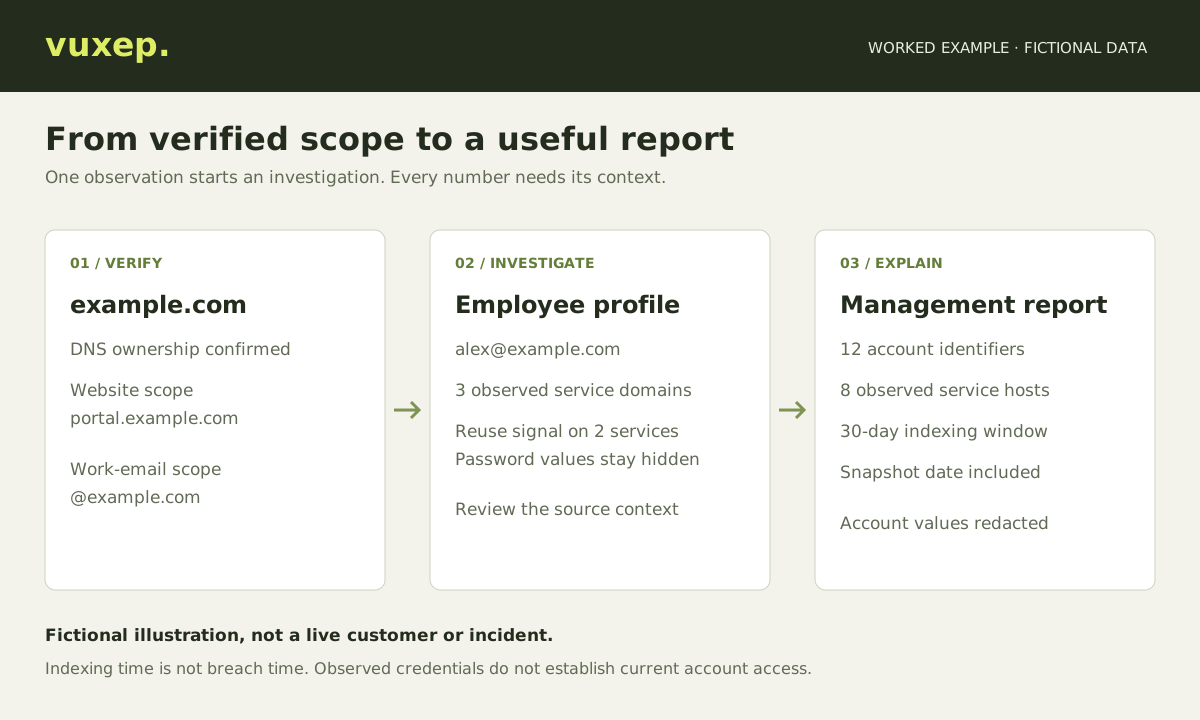
Evaluate Vuxep when your security or IT team needs a focused analyst workspace for its own domains: follow an observed work account into a password-free employee profile, explain configured priority reasons, and produce a redacted PDF for management. Inspect those outputs in the worked example, then compare them with the response automation and coverage your organization requires.
A Vuxep result is indexed evidence, not proof that a password still works. First-indexed dates describe when a record entered the index, not when a breach or infection happened.
SpyCloud
alternatives, answered.
Is SpyCloud free?
SpyCloud offers a free Check Your Exposure tool that returns a domain-level summary for a work email; the page says record-level detail requires talking with a SpyCloud expert [6]. API access comes with a paid license [5].
What is the best SpyCloud alternative?
It depends on what you use SpyCloud for. If session cookies and identity provider remediation are essential, choose a platform that offers them [3]. If you mainly need to investigate and monitor plaintext credential records for domains you own, Vuxep is one option to evaluate.
SpyCloud vs Vuxep: which should I choose?
SpyCloud covers breaches, malware, phishing and combolists with cookie data, an API and many integrations [2] [4]. Vuxep is narrower: credential exposure evidence scoped to verified domains, with dashboards, reports and alerts but no API or remediation workflow.
Does Vuxep provide session cookies like SpyCloud?
No. Vuxep indexes credential records (hostname, URL, account, password) and does not provide session cookies or infected-device data. SpyCloud describes stolen session cookies as part of its recaptured data [2].
Evaluate the analyst workspace separately from automated response.
For a team evaluating manual credential investigations, Vuxep's concrete workflow is a domain-scoped search, an employee profile, an auditable export, and a redacted report. Test those outputs against your own requirements during a walkthrough.
- 01
Follow one work account
Open an employee profile from a scoped finding and inspect observed services, reuse groups, and the sample boundary.
- 02
Explain the priority
Mark a known privileged work email and confirm that the matching result explains the configured reason.
- 03
Inspect the deliverable
Compare a detailed credential export with the management PDF and confirm which values each audience receives.
Documentation behind the comparison.
By the Vuxep team. Reviewed October 19, 2026. Products, plans, and threat activity change; check the original source for current details.
Compare other services.
Bring your evaluation
to a walkthrough.
Explore verified-domain searches, employee profiles, notifications, and redacted reporting with our team. Decide whether the workflow fits your organization.