A Flare alternative. Built for credential investigations.
Flare is a broad threat intelligence and exposure management platform. Vuxep is a narrower workspace for investigating and monitoring exposed credentials on domains your organization has verified.
A comparison published by Vuxep, one of the vendors being evaluated. We are not affiliated with or endorsed by Flare.
Start with what each service is for.
Flare is a threat intelligence and threat exposure management platform that monitors the dark web, stealer log markets and clear-web sources for exposed credentials, fraud, phishing domains and brand abuse [1] [2]. It also offers modules for executive protection, lookalike-domain monitoring, attack surface discovery, and a data licensing program for security vendors [1].
Its Identity Exposure Management connects to Microsoft Entra ID to validate exposed credentials and trigger password resets, session revocations and account lockdowns [2]. The Flare API covers global search, tenant event export, leaked credentials by domain and leaked cookie monitoring, with Python and Go SDKs [3].
Flare vs. Vuxep
Flare details link to its own documentation or reputable reporting. Check them against your requirements.
Scroll across the table to compare both services.
| What to compare | Flare | Vuxep Verified organization workspace |
|---|---|---|
| Primary focus | Threat intelligence and exposure management across dark web and clear web, including fraud, phishing and brand monitoring. [1] | Private credential-exposure investigation and monitoring for domains an organization has verified via DNS TXT record. |
| Data sources | Stealer logs, leaked credentials, cybercrime forums, ransomware leak sites and messaging channels. [1] | Credential exposure evidence for verified-domain investigations. No session cookies, device data or malware-family attribution. |
| Organization monitoring | Continuous monitoring with Entra ID validation and automated password resets, session revocation and account lockdown. [2] | Nightly organization dashboard, employee exposure profiles with password-reuse signals, priority rules, and alerts for newly indexed matches. No automated remediation workflow. |
| Investigation workflow | Global search across Flare's collected events, plus export of events tied to your tenant. [3] | Search by domain tree, exact hostname, work-email domain or exact work email. Full records, including plaintext passwords, and CSV export within verified scope. |
| API and integrations | Documented APIs and SDKs; integrations with Jira, Teams, Slack, Entra ID, Okta, Splunk and Azure Sentinel. [2] | No public API and no SIEM or identity provider integrations today. Notifications via email, Slack, Microsoft Teams, Discord and signed webhooks. |
| Access and pricing | Free trial with no credit card and no procurement cycle; demo also available. [2] | Sales-led plans with no free public search or self-serve signup. Admin and Viewer roles, audit log and email OTP sign-in. |
Choose Flare if this sounds like you.
Flare is likely the better fit if you want broad dark web and online threat monitoring that also covers fraud, phishing domains and brand abuse, Entra ID remediation, a self-serve trial, or an API with SDKs.
Consider Vuxep for verified-domain investigations.
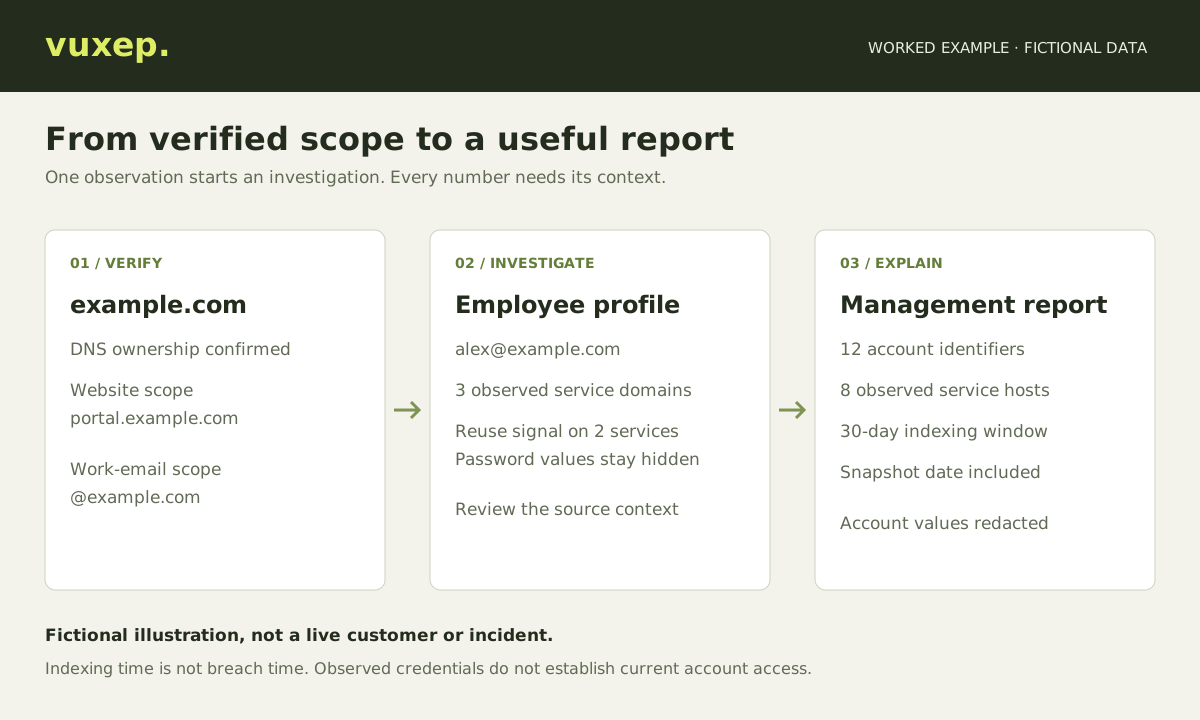
Evaluate Vuxep when the team responsible for credential findings wants a workspace centered on verified website and work-email scope. Compare the domain search, employee profile, targeted notification payloads, and redacted report against your process. Use a representative investigation to decide whether that focused evidence model is sufficient.
A Vuxep result is indexed evidence, not proof that a password still works. First-indexed dates describe when a record entered the index, not when a breach or infection happened.
Flare
alternatives, answered.
Is Flare free?
Flare advertises a free trial with no credit card and no procurement cycle [2]. The pages we reviewed did not list public prices.
What is the best Flare alternative?
If you rely on Flare for brand, fraud and dark web forum monitoring or Entra ID remediation, look for a platform with those capabilities [1] [2]. If you mainly need credential-exposure investigations for domains you own, Vuxep is one option to evaluate.
Flare vs Vuxep: which should I choose?
Flare is a broad threat intelligence platform with an API and identity provider remediation [2] [3]. Vuxep is narrower: credential exposure evidence for verified domains, with dashboards, reports and alerts, but no API or remediation workflow.
How does Vuxep's scope differ from Flare's?
Flare describes broad threat intelligence coverage across online sources [2]. Vuxep focuses on credential exposure investigations within verified organization domains; it is not a general conversation or forum search engine.
Evaluate a focused credential workflow for your team.
Vuxep organizes credential findings around verified websites and work-email domains. The walkthrough should establish whether that narrower evidence model serves the people who will investigate, share, and receive your findings.
- 01
Compare the two scopes
Run website-domain and work-email-domain searches separately, then explain the populations and any overlap.
- 02
Route an appropriate payload
Compare Slack/Teams account-and-host examples with a signed webhook's count and workspace link.
- 03
Check reporting boundaries
Inspect the selected indexing window, snapshot time, and redaction in a management report.
Documentation behind the comparison.
By the Vuxep team. Reviewed October 19, 2026. Products, plans, and threat activity change; check the original source for current details.
Compare other services.
Bring your evaluation
to a walkthrough.
Explore verified-domain searches, employee profiles, notifications, and redacted reporting with our team. Decide whether the workflow fits your organization.