A DeHashed alternative. For verified-domain investigations.
DeHashed is a breach search, monitoring, API and WHOIS toolset used by investigators and individuals. Vuxep is a private workspace where organizations investigate credential exposure on domains they have verified.
A comparison published by Vuxep, one of the vendors being evaluated. We are not affiliated with or endorsed by DeHashed.
Start with what each service is for.
DeHashed describes itself as a security and investigation tool that collects sensitive data posted on the clear web and deep web, so users can search breached usernames, email addresses, IP addresses, names, hashes and more [2]. Its search covers email, username, IP address, name, address, phone and VIN, plus a domain scan, and it publishes a guide to search operators and regex [2]. Alongside search it offers breach monitoring, an API, and historical WHOIS and reverse WHOIS data [1].
DeHashed has both free and paid tiers. Its Standard monitoring plan is free with up to 10 tasks. Domain monitoring costs $29.99 per domain per month, and the Enterprise level costs $99.99 per month [3]. The API is pay-per-query, with 500 credits for $15.00, and needs a Search subscription [4]. The FAQ lists analysts, journalists, cybersecurity companies and everyday people among its users and says DeHashed works with law enforcement agencies. Government, law enforcement and non-profit organizations get free access. To limit abuse, DeHashed rate-limits searches and locks accounts that search many accounts that may not belong to them [5].
DeHashed vs. Vuxep
DeHashed details link to its own documentation or reputable reporting. Check them against your requirements.
Scroll across the table to compare both services.
| What to compare | DeHashed | Vuxep Verified organization workspace |
|---|---|---|
| Primary focus | Breach data search for security and OSINT investigations, plus monitoring, an API and WHOIS history. [1] | Credential-exposure investigation and monitoring, limited to an organization's own verified domains. |
| Data sources | Data posted on the clear web and deep web. The FAQ says it also includes people-search (white pages) databases. [5] | Credential exposure evidence for verified-domain investigations, including available account and service context. |
| Who can search what | Account holders can search many identifier types. Anti-abuse controls include rate limiting, locks on accounts that search many accounts that may not belong to them, and some sensitive data that only law-enforcement-status users can access. [5] | Only domains the organization verifies with a DNS TXT record: search by website domain tree, exact hostname, work-email domain or exact work email. Other organizations' accounts cannot be searched. |
| Organization monitoring | Task-based monitoring with alerts by text message, email or webhook. Domain monitoring is a paid add-on. [3] | Nightly organization dashboard, employee exposure profiles, priority rules for critical services and privileged emails, branded PDF reports, and alerts for newly indexed matches. |
| API and integrations | Pay-per-query API sold in credit packs (500 credits for $15.00). Using the API requires a Search subscription. [4] | No public customer API yet. Notifications go out by email, Slack, Microsoft Teams, Discord and signed webhooks, and authorized users can export CSV within verified scope. |
| Access and pricing | Free Standard monitoring (10 tasks), domain monitoring at $29.99 per domain per month, Enterprise at $99.99 per month. Government and non-profit organizations can ask for free access. [3] | Sales-led plans for organizations. No free public search, no self-serve signup. |
Choose DeHashed if this sounds like you.
DeHashed is likely the better fit if you need self-serve OSINT lookups across many identifier types, including names, phones, addresses and VINs. It also suits teams that want historical WHOIS, low-cost pay-per-query API access, or free monitoring for a few identifiers.
Consider Vuxep for verified-domain investigations.
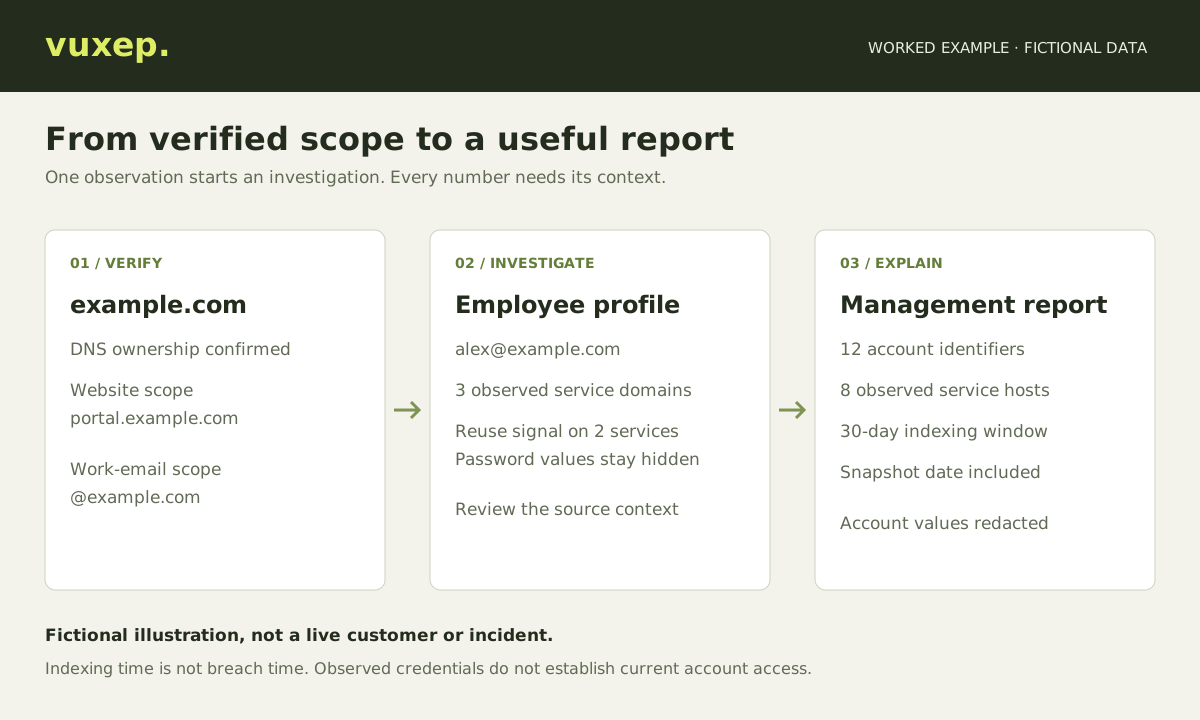
Evaluate Vuxep when several colleagues need to investigate company credential exposure with different permissions. Ask a viewer to inspect an employee profile, ask an administrator to configure a priority and alert, then review the audit trail and redacted report. This makes the team workflow a concrete part of the comparison.
A Vuxep result is indexed evidence, not proof that a password still works. First-indexed dates describe when a record entered the index, not when a breach or infection happened.
DeHashed
alternatives, answered.
Is DeHashed free?
Partly. The Standard monitoring plan is free with up to 10 tasks, and domain monitoring and Enterprise monitoring are paid [3]. API access is sold as credits and requires a Search subscription [4]. DeHashed also gives free access to government, law enforcement and non-profit organizations [5].
Is DeHashed legal and safe to use?
DeHashed says it works with law enforcement agencies and logs how many records a user accesses, not which ones. It also rate-limits searches and locks accounts that look up many accounts that may not belong to them [5]. Whether a particular search is lawful depends on your jurisdiction and purpose. Companies should limit lookups to accounts they are responsible for.
Does DeHashed have an API?
Yes. DeHashed sells pay-per-query API credits, starting at 500 credits for $15.00, and says a Search subscription is required to use the API [4].
What is the best DeHashed alternative for companies?
It depends on the job. For broad OSINT lookups and WHOIS history, DeHashed is still a strong option [1]. A company that wants credential-exposure search limited to its own verified domains, with employee exposure profiles, alerts and reports, can consider Vuxep. Vuxep is sales-led and has no public API.
Test delegated investigation inside your organization's scope.
Vuxep's fit is a shared workspace where colleagues investigate verified organizational exposure with different configuration permissions. Evaluate that team workflow using representative fictional records before making a buying decision.
- 01
Compare Admin and Viewer
Have a viewer investigate and read settings, then confirm that membership and notification changes require an administrator.
- 02
Review account context
Move from an exact work email to its observed services and readable priority reasons.
- 03
Review the audit trail
Check that searches, exports, and profile views appear in the organization's audit view with credential values excluded from action details.
Documentation behind the comparison.
By the Vuxep team. Reviewed October 19, 2026. Products, plans, and threat activity change; check the original source for current details.
Compare other services.
Bring your evaluation
to a walkthrough.
Explore verified-domain searches, employee profiles, notifications, and redacted reporting with our team. Decide whether the workflow fits your organization.