A LeakCheck alternative. Scoped to the domains you verify.
LeakCheck is a fast, low-cost data breach search engine with monitoring and an API. Vuxep is a private workspace where organizations investigate credential exposure on domains they have verified.
A comparison published by Vuxep, one of the vendors being evaluated. We are not affiliated with or endorsed by LeakCheck.
Start with what each service is for.
LeakCheck is a data breach search engine run by a UK-registered company (number 12101959) based in London. It searches by email, username, phone, hash or domain, and says it holds more than 10 billion records from more than 1,366 breach sources [1]. It indexes info-stealer logs alongside classic breach data, and each stealer-log record shows the origin URL, login and password [4].
Access is self-serve. Free checks show which breaches contain an identifier and which types of data leaked, but not the data itself. Paid plans are Basic at $2.99 per day, Monthly at $9.99, Lifetime at $69.99 once, and Enterprise from $179 per quarter or $716 per year [2]. Enterprise adds domain monitoring, reverse search by password and domain, stealer-log search by website, and BulkCheck [2]. There is also a free Public API and a Pro API that returns full records [3].
LeakCheck vs. Vuxep
LeakCheck details link to its own documentation or reputable reporting. Check them against your requirements.
Scroll across the table to compare both services.
| What to compare | LeakCheck | Vuxep Verified organization workspace |
|---|---|---|
| Primary focus | A data breach search engine for individuals, security teams, online businesses and regulators. [1] | Credential-exposure investigation and monitoring, limited to an organization's own verified domains. |
| Data sources | Leaked data published on forums and other platforms, plus info-stealer logs. The vendor reports 10B+ records from more than 1,366 breach sources. [1] | Credential exposure evidence for verified-domain investigations, including available account and service context. |
| Who can search what | Search by email, username, phone and keyword within daily plan quotas. Reverse search by password and domain, and stealer-log search by website, require Enterprise. [2] | Only domains the organization verifies with a DNS TXT record: search by website domain tree, exact hostname, work-email domain or exact work email. Other organizations' accounts cannot be searched. |
| Organization monitoring | Breach monitors (25 to 1,000 depending on plan) with alerts through email, Slack, Discord and webhooks. Domain monitoring is on Enterprise. [2] | Nightly organization dashboard, employee exposure profiles, priority rules for critical services and privileged emails, branded PDF reports, and alerts for newly indexed matches. |
| API and integrations | A free Public API (1 request/s) and Pro API v2 (3 requests/s, upgradable), with a Python package and an OpenAPI 3.1 spec. [3] | No public customer API yet. Notifications go out by email, Slack, Microsoft Teams, Discord and signed webhooks, and authorized users can export CSV within verified scope. |
| Access and pricing | Self-serve: Basic $2.99/day, Monthly $9.99/month, Lifetime $69.99 once, and Enterprise from $179/quarter or $716/year. [2] | Sales-led plans for organizations. No free public search, no self-serve signup. |
Choose LeakCheck if this sounds like you.
LeakCheck is likely the better fit if you want inexpensive, instant self-serve lookups on emails, usernames or phone numbers, a free or low-cost API to build into your own product, or bulk checks of user emails against third-party breaches.
Consider Vuxep for verified-domain investigations.
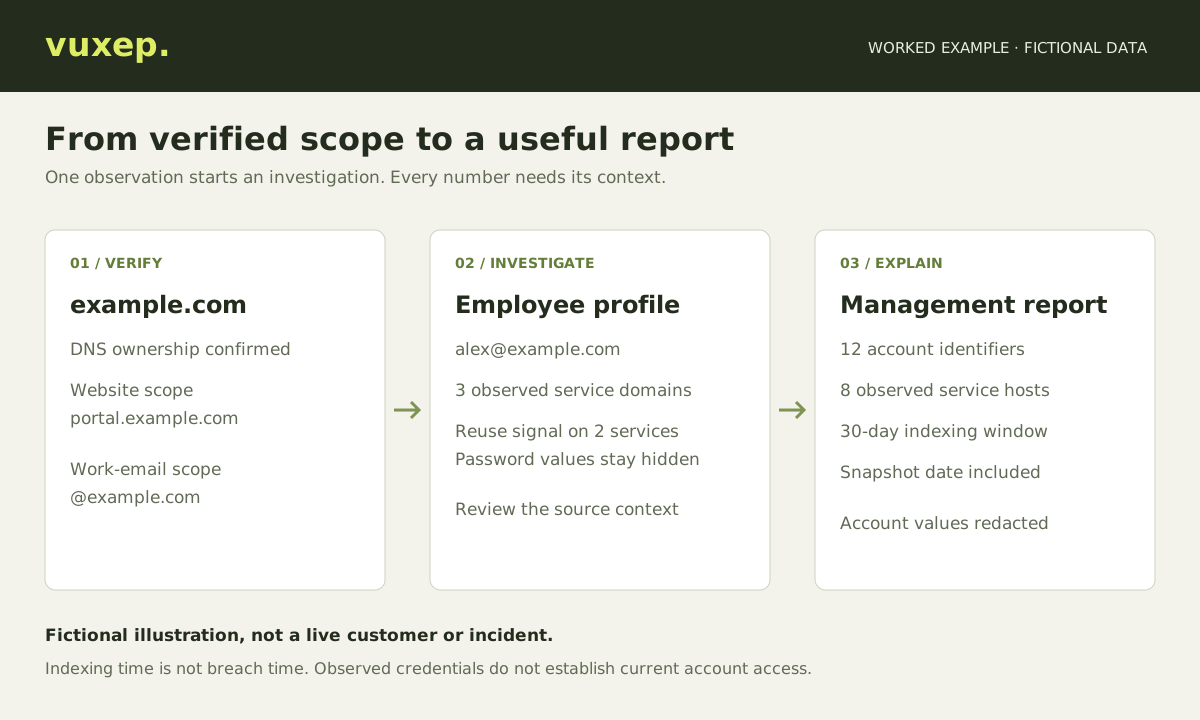
Evaluate Vuxep when your buying decision includes an ongoing team review rather than only a lookup. Test how an employee profile groups services, how an administrator-defined priority is explained, and what a viewer can export. Compare the management PDF and chat/webhook payloads with your reporting and handling requirements.
A Vuxep result is indexed evidence, not proof that a password still works. First-indexed dates describe when a record entered the index, not when a breach or infection happened.
LeakCheck
alternatives, answered.
Is LeakCheck free?
LeakCheck offers a few free checks that show which breaches contain an email, username or phone number and which data types leaked, but not the data itself. A free Public API returns the same information [2]. Paid plans start at $2.99 per day [2].
Is LeakCheck legit and safe to use?
LeakCheck says it is a registered UK company (number 12101959) and does not store search queries. It also supports searching by the SHA-256 hash of an email for extra privacy [1]. Its terms prohibit using the service to stalk, harass or dox anyone, or to collect third-party personal data without a lawful basis [5].
Does LeakCheck include stealer logs?
Yes. LeakCheck indexes info-stealer logs next to breach data, and they appear in regular email and username results. Searching stealer logs by website requires the Enterprise plan [4].
What is the best LeakCheck alternative for companies?
For low-cost self-serve lookups and an API, LeakCheck itself is a reasonable choice [2]. A company that wants searches limited to its own verified domains, with employee exposure profiles, team alerts and reports, can consider Vuxep. Vuxep is sales-led and has no public API.
Compare the ongoing team review, as well as a single lookup.
Vuxep adds an organization workflow around scoped findings: employee profiles, administrator-defined priority reasons, viewers, audit visibility, and redacted reporting. Ask whether those outputs matter to the team that will own the process.
- 01
Group related services
Open a work account's exposure profile and inspect observed service groups and reuse signals.
- 02
Send an understandable alert
Create a targeted rule in a walkthrough and inspect an account-and-host chat example with no password.
- 03
Share the appropriate output
Compare scoped CSV evidence with the redacted PDF instead of assuming every export contains the same fields.
Documentation behind the comparison.
By the Vuxep team. Reviewed October 19, 2026. Products, plans, and threat activity change; check the original source for current details.
Compare other services.
Bring your evaluation
to a walkthrough.
Explore verified-domain searches, employee profiles, notifications, and redacted reporting with our team. Decide whether the workflow fits your organization.