A Hudson Rock alternative. Focused on credential records.
Hudson Rock specializes in infostealer intelligence with machine-level infection context. Vuxep focuses on searching and monitoring exposed credential records for the domains your organization has verified.
A comparison published by Vuxep, one of the vendors being evaluated. We are not affiliated with or endorsed by Hudson Rock.
Start with what each service is for.
Hudson Rock is a Tel Aviv-based cybercrime intelligence company focused on infostealer malware. It describes its database as composed of millions of machines compromised by infostealers in global malware campaigns, and says its Cavalier platform is based on forensic technologies developed at the IDF's 8200 Unit [1].
Cavalier provides per-infection context, including browser credentials with plaintext passwords, cookies, IP address, infection date, operating system, malware path, installed antivirus and stolen files, delivered via web, API, JSON and email [1]. The Cavalier API supports lookups by email, username, IP or CIDR range and domain [2], and the documentation says Hudson Rock integrates data from recently compromised computers within days [3]. The company also offers Bayonet, a prospecting tool for security sales teams and MSSPs, and free lookup tools [1].
Hudson Rock vs. Vuxep
Hudson Rock details link to its own documentation or reputable reporting. Check them against your requirements.
Scroll across the table to compare both services.
| What to compare | Hudson Rock | Vuxep Verified organization workspace |
|---|---|---|
| Primary focus | Infostealer intelligence for security teams, cyber insurers, third-party risk providers, MSSPs and government agencies. [1] | Private credential-exposure investigation and monitoring for domains an organization has verified via DNS TXT record. |
| Data sources | Infostealer-infected computers: credentials, cookies, stolen files and machine metadata, plus a compromised leaked databases category. [1] | Credential exposure evidence for verified-domain investigations. No session cookies, device data or malware-family attribution. |
| Organization monitoring | Monitoring of compromised employees, customers, vendors and executives, with email alerts and identity provider-driven session revocation. [1] | Nightly organization dashboard, employee exposure profiles with password-reuse signals, priority rules, and alerts for newly indexed matches. No automated remediation workflow. |
| Investigation workflow | Investigation modules with file and term search, AI infection analysis, password search and keyword search. [2] | Search by domain tree, exact hostname, work-email domain or exact work email. Full records, including plaintext passwords, and CSV export within verified scope. |
| API and integrations | RESTful API with JSON responses; SIEM (Splunk, ArcSight, LogRhythm), SOAR and EDR integrations. [1] | No public API and no SIEM or identity provider integrations today. Notifications via email, Slack, Microsoft Teams, Discord and signed webhooks. |
| Access and pricing | Free domain and email lookups and an application page for a free API key; Cavalier enterprise access via demo. [1] | Sales-led plans with no free public search or self-serve signup. Admin and Viewer roles, audit log and email OTP sign-in. |
Choose Hudson Rock if this sounds like you.
Hudson Rock is likely the better fit if you need machine-level infection context (malware path, infection date, antivirus, cookies), free lookups before buying, an API, or identity provider-driven response to compromised accounts.
Consider Vuxep for verified-domain investigations.
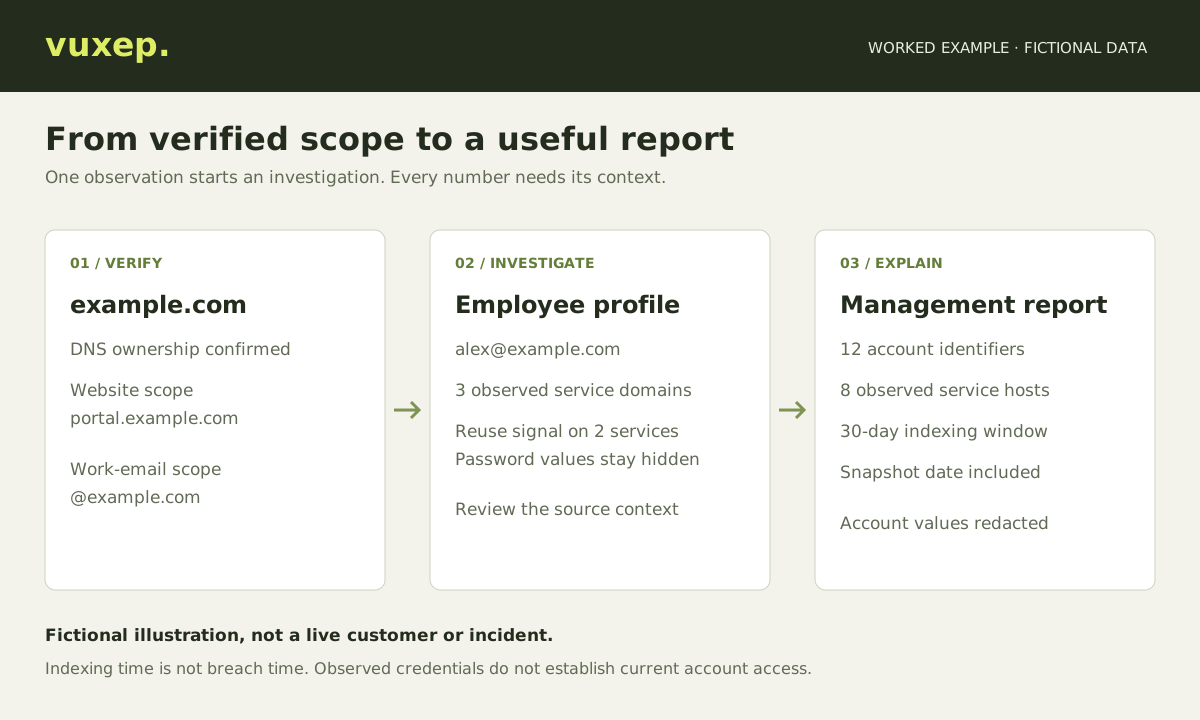
Evaluate Vuxep for an account-centered review when your team already obtains current device and identity information from its own systems. Start with a verified work email, inspect observed services and password-reuse groups, and share a redacted report. The walkthrough should establish whether that workflow meets your question without infected-device attribution.
A Vuxep result is indexed evidence, not proof that a password still works. First-indexed dates describe when a record entered the index, not when a breach or infection happened.
Hudson Rock
alternatives, answered.
Is Hudson Rock free?
Hudson Rock offers free tools, including domain and email or username searches, Cavalier GPT and a messaging bot, and lists a page to apply for a free API key. Cavalier is its enterprise platform [1].
What is Hudson Rock Cavalier?
Cavalier is Hudson Rock's enterprise threat intelligence platform, built on data from infostealer-infected computers and offering credentials, cookies and infection metadata via web, API and email [1].
Hudson Rock vs Vuxep: what is the difference?
Hudson Rock centers on infostealer-infected machines with device context and an API [1] [2]. Vuxep provides credential exposure evidence for verified domains, without device data or an API, and adds dashboards, PDF reports and alerts.
What is the best Hudson Rock alternative?
If you need per-machine infection details or an API, look for vendors that provide them [1]. If your team mainly needs to investigate and monitor exposed credentials on domains it owns, Vuxep is one option to evaluate.
Decide whether your question needs device attribution or account context.
Vuxep's employee profile connects a work email to observed services. It can suit an account-centered review where your organization supplies current endpoint and identity context. It does not identify an infected device for you.
- 01
Keep attribution explicit
Start with a fictional work address and distinguish service observations from any claims about the device or employee.
- 02
Inspect reuse groups
Review observed password reuse across services without copying a password into a report.
- 03
Check ownership boundaries
Confirm that adding an unverified domain does not authorize an organization profile or search.
Documentation behind the comparison.
By the Vuxep team. Reviewed October 19, 2026. Products, plans, and threat activity change; check the original source for current details.
Compare other services.
Bring your evaluation
to a walkthrough.
Explore verified-domain searches, employee profiles, notifications, and redacted reporting with our team. Decide whether the workflow fits your organization.