An Intelligence X alternative. Focused on your own domains.
Intelligence X is a broad OSINT search engine and data archive with free and paid licenses. Vuxep is a private workspace where organizations investigate credential exposure on domains they have verified.
A comparison published by Vuxep, one of the vendors being evaluated. We are not affiliated with or endorsed by Intelligence X.
Start with what each service is for.
Intelligence X is a search engine and data archive founded in 2018 by Peter Kleissner. It is based in Prague, Czech Republic, and says all of its servers are in the EU [2]. It searches selectors such as email addresses, domains (with wildcards), URLs, IPs and CIDR ranges, phone numbers and crypto addresses. Its listed sources include paste sites, Tor and I2P, data leaks, WHOIS data and the public web. The vendor says it searches more than 200 billion records and keeps historical copies of websites and documents [1].
Access comes in tiers. The free options are a few searches a day without an account, a Free account, an Academia tier and a 7-day trial. Paid licenses are billed yearly: Researcher at €2,500, API at €7,000, Identity Portal at €10,000 and Enterprise at €20,000 [1]. The Identity Portal is a separate product built on the same data set. It lists matching lines, exports leaked accounts and stealer logs, and adds the Leaks API [1]. Intelligence X is operated by Kleissner Investments s.r.o., and its terms allow it to end accounts used for unlawful purposes. Commercial use of a free license beyond trial purposes is prohibited [3].
Intelligence X vs. Vuxep
Intelligence X details link to its own documentation or reputable reporting. Check them against your requirements.
Scroll across the table to compare both services.
| What to compare | Intelligence X | Vuxep Verified organization workspace |
|---|---|---|
| Primary focus | A general-purpose OSINT search engine and data archive covering leaks, the darknet, pastes, WHOIS and the public web. [1] | Credential-exposure investigation and monitoring, limited to an organization's own verified domains. |
| Data sources | Paste sites, Tor and I2P, Wikileaks and Cryptome, data leaks, WHOIS data, the public web and other material. The vendor says it searches more than 200 billion records. [1] | Credential exposure evidence for verified-domain investigations, including available account and service context. |
| Who can search what | Selector search for anyone within per-tier daily limits: 2 searches a day without an account, 50 on Free and 200 on Researcher. [1] | Only domains the organization verifies with a DNS TXT record: search by website domain tree, exact hostname, work-email domain or exact work email. Other organizations' accounts cannot be searched. |
| Organization monitoring | Alerts on selectors, from 10 alerts up to unlimited depending on tier. The Identity Portal lists leaked accounts and exports stealer logs. [1] | Nightly organization dashboard, employee exposure profiles, priority rules for critical services and privileged emails, branded PDF reports, and alerts for newly indexed matches. |
| API and integrations | The Search API is available on every tier under fair use. Integration rights start at the API tier, and the Leaks API comes with Identity Portal and Enterprise. [1] | No public customer API yet. Notifications go out by email, Slack, Microsoft Teams, Discord and signed webhooks, and authorized users can export CSV within verified scope. |
| Access and pricing | Free, Academia and 7-day trial tiers. Paid licenses cost €2,500 to €20,000 per year. [1] | Sales-led plans for organizations. No free public search, no self-serve signup. |
Choose Intelligence X if this sounds like you.
Intelligence X is likely the better fit for researchers and threat-intelligence teams who need to search well beyond credentials, including darknet pages, pastes, leaked documents, WHOIS and historical web copies. It also suits teams that want a self-serve API with integration rights.
Consider Vuxep for verified-domain investigations.
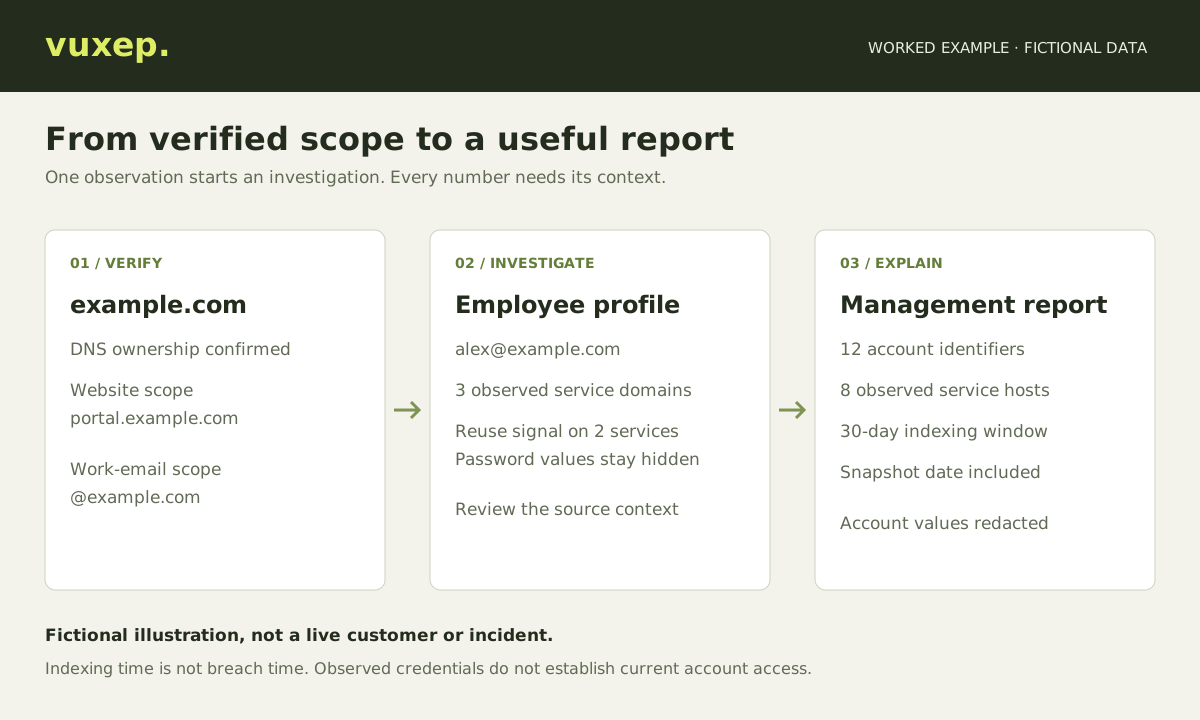
Evaluate Vuxep when the primary question is employee or website credential exposure rather than document and selector research. Compare counts using the documented units, follow one work account across observed services, and inspect the snapshot date and redaction in a management report. The methodology and worked example are available before a sales call.
A Vuxep result is indexed evidence, not proof that a password still works. First-indexed dates describe when a record entered the index, not when a breach or infection happened.
Intelligence X
alternatives, answered.
Is Intelligence X free?
There are free options: 2 searches a day without an account, a Free account with 50 searches a day, an Academia tier and a 7-day trial. Paid licenses start at €2,500 per year [1].
Is Intelligence X legal to use?
Intelligence X is operated by Kleissner Investments s.r.o. in Prague [3]. The company says its servers are in the EU and subject to EU privacy rules [2]. Its terms allow it to end accounts used for unlawful purposes or unauthorized access [3]. Whether a specific search is lawful depends on your jurisdiction and purpose.
How much does Intelligence X cost?
Paid licenses are billed yearly: Researcher costs €2,500, API €7,000, Identity Portal €10,000 and Enterprise €20,000. Additional users can be added on request for an extra charge [1].
What is the best Intelligence X alternative for companies?
For broad OSINT research across darknet, paste and leak sources, Intelligence X is hard to replace [1]. A company that mainly wants credential-exposure monitoring limited to its own verified domains, with employee profiles, alerts and reports, can consider Vuxep. Vuxep is sales-led and has no public API.
Define the credential question before comparing record counts.
Vuxep's unit is a credential observation connected to an account and service. It suits an organization evaluating repeatable employee and website exposure reviews. Use the methodology to compare equivalent units rather than a vendor's headline corpus size.
- 01
Name each unit
Distinguish exposure records, account identifiers, and observed services before comparing totals.
- 02
Check temporal meaning
Confirm that a newly indexed record is labelled as index activity rather than a newly confirmed breach.
- 03
Inspect a report
Check verified-domain coverage, affected hosts, and the snapshot's freshness before exporting a redacted management PDF.
Documentation behind the comparison.
By the Vuxep team. Reviewed October 19, 2026. Products, plans, and threat activity change; check the original source for current details.
Compare other services.
Bring your evaluation
to a walkthrough.
Explore verified-domain searches, employee profiles, notifications, and redacted reporting with our team. Decide whether the workflow fits your organization.